Post
Teaching Steel Industry Equipment to See
A practical look at how AI, computer vision, and deterministic geometry can work together to turn messy real-world perception into reliable measurements a machine can actually use.
Teaching Steel Industry Equipment to See
 Ali MaghamiSina Alborzi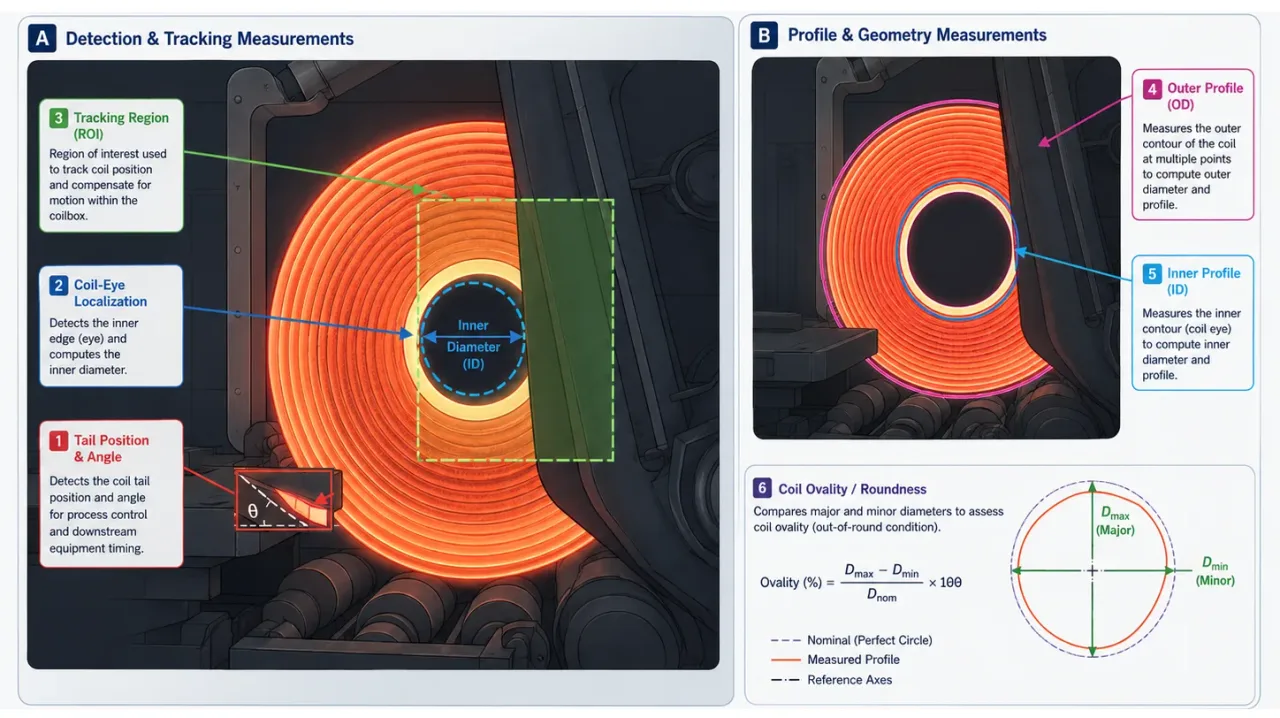
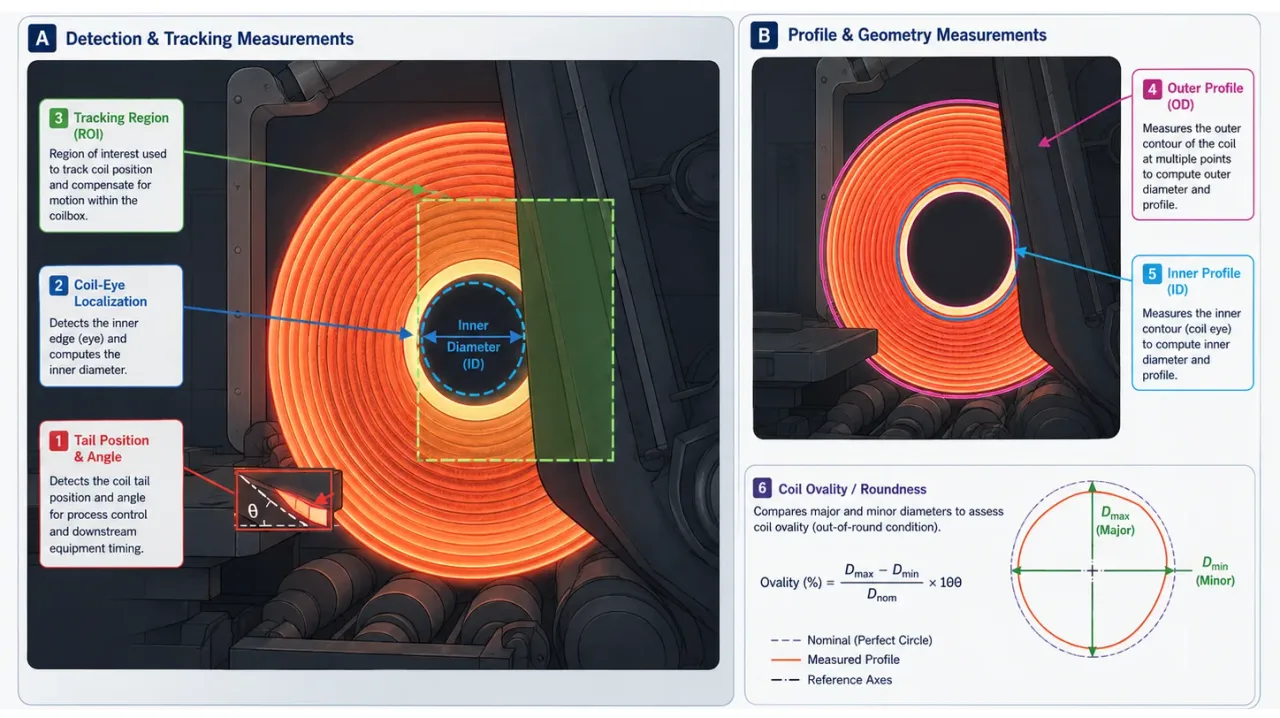
Images are AI-generated and used for illustrative purposes, as permission to publish original project imagery was not available.
CoilSense is a real-time computer-vision system developed to give heavy industrial equipment visual awareness of a fast-moving steel process.
The system uses industrial cameras, AI-based feature detection, classical computer vision, geometric measurement, GPU inference, and PLC integration to turn video into actionable process information.
It was designed for a particularly difficult vision environment: glowing steel, high temperatures, steam, dust, flying scale, equipment occlusion, and rapid motion.
The goal was not simply to detect objects in an image.
The vision pipeline identifies features such as the coil tail and inner coil geometry, then uses those detections to calculate measurements including:
This required combining AI-based perception with deterministic computer-vision and geometry algorithms.
AI handles the difficult task of finding useful features in noisy and partially occluded images. Geometry then converts those features into repeatable engineering measurements.
AI handles perception. Deterministic algorithms handle measurement.
For moving industrial equipment, latency matters as much as accuracy.
I developed the acquisition and processing pipeline so camera capture, inference, and measurement could operate concurrently rather than sequentially.
The system was designed around:
Industrial Camera → Image Acquisition → AI Inference → Geometry → Process State → PLC / Operator
The implementation included GPU-accelerated inference, concurrent image processing, latest-frame prioritization, industrial networking, and integration with the machine control system.
This made the architecture closer to a real-time robotics perception stack than a traditional image-analysis application.
The project covered much more than model development.
It included:
Many of the most important design decisions were system-level decisions: camera placement, occlusion, environmental protection, latency, compute architecture, and how perception outputs should interact with automation.
This project reinforced an important principle for industrial AI:
the model is only one part of the system.
Reliable Physical AI requires perception, deterministic engineering logic, real-time software, hardware, networking, and control integration to work together.
The real challenge is not:
Can AI recognize something?
It is:
Can perception become reliable information that a physical machine can use?
That is the problem CoilSense was designed to solve.